As an Amazon Associate, we earn from qualifying purchases. Some links on this site are affiliate links at no extra cost to you. Our recommendations are based on thorough research and editorial judgment.


What Lumen Rating Do I Need for Safe Night Cycling?

For safe night cycling, we need a minimum of 600 lumens to guarantee visibility. This is essential as over 50% of cycling fatalities occur in low-light situations, mainly between 6 and 9 p.m. For urban commuting, front lights should range from 250 to 500 lumens, while rear lights should be 100 to 200 lumens. In darker areas, front lights should be between 200 and 600 lumens. Understanding these specifications is important for enhancing our safety on the road at night.
Key Takeaways
- For urban commuting, front lights should be between 250 to 500 lumens, while rear lights need 100 to 200 lumens for safety.
- Rural roads require brighter lighting; front lights should range from 200 to 600 lumens to ensure visibility.
- Mountain biking lights ideally range from 800 to 1500 lumens for performance in challenging terrains.
- A minimum brightness of 600 lumens is recommended for safe night cycling due to visibility requirements.
- Consider battery life; higher outputs shorten runtimes, so balance lumen output with battery capacity for safer rides.
Understanding Lumen Ratings
You may be interested


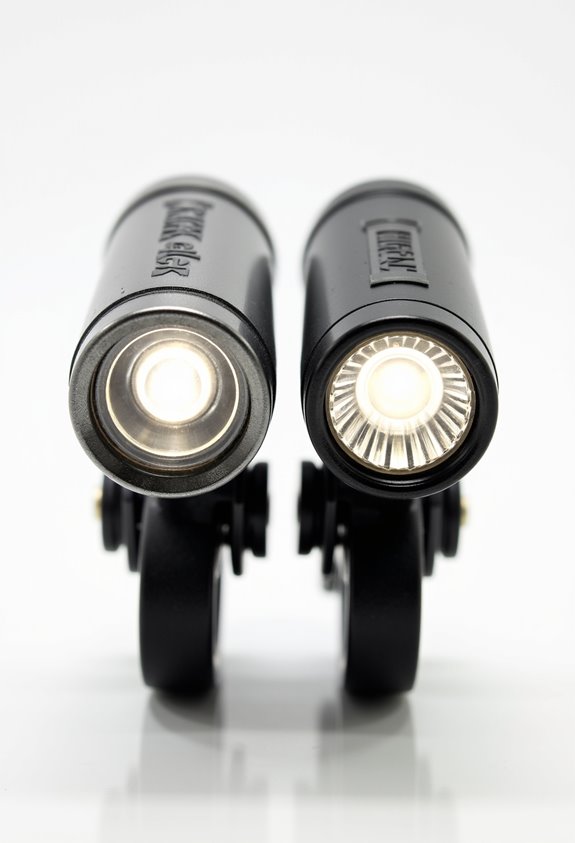
When we discuss lumens, we’re referring to a measure that quantifies the total visible light emitted by a source. This lumen measurement is vital for determining the brightness of our bike lights for night cycling. Higher lumen values indicate brighter lights, but effective lighting also depends on factors like beam pattern and design.
It’s important to note that lumens differ from lux, which focuses on light intensity on surfaces.
We should also consider the flicker rate of our lights, as it can impact our visibility.
For safe night cycling, a minimum of 600 lumens is advised. Different riding conditions require varying lumen outputs, so understanding these factors is imperative for our safety and performance. Additionally, features like multiple lighting modes can enhance adaptability for various riding scenarios.
Lumen Needs for Urban Commuting

For urban commuting, understanding our lumen needs is essential to assure safety and visibility. Front commuter bike lights should typically range from 200 to 500 lumens to guarantee we’re seen by others on the road. In well-lit areas, 50 to 200 lumens can suffice, reducing glare and focusing on visibility without contributing to urban light pollution. Rear lights require between 50 and 100 lumens for visibility, with flashing modes enhancing attention from traffic. During daylight, 20 to 100 lumens can increase our presence in city traffic. Adjustable modes help adapt to changing light conditions, allowing us to balance brightness and battery life effectively. By following these guidelines, we enhance our safety while traversing urban environments. Additionally, it’s crucial to choose lights with a water resistance rating to ensure performance during inclement weather.
Recommended Products

LED Light Bars Application: YHTAUTO LED Light Bar For Motorcycle ATV UTV Dirt Bike 4x4 Pickup Truck Boat Trailer, you can explore additional applications such as off-road adventures, construction projects, or home workshop use

LED Light Bars Application: YHTAUTO LED Light Bar for Motorcycle ATV UTV Dirt Bike 4x4 Pickup Truck Boat Trailer, you can explore additional applications such as off-road adventures, construction projects, or home workshop use

LED Light Bars Application: YHTAUTO LED Light Bar for For Motorcycle ATV UTV Dirt Bike 4x4 Pickup Truck Boat Trailer, you can explore additional applications such as off-road adventures, construction projects, or home workshop use
Lumen Requirements for Road Cycling

Lumen requirements for road cycling at night are essential for ensuring safety and visibility. Each state has specific lumen regulations that dictate the minimal light visibility needed. For instance, New York mandates at least 500 feet of visibility for front lights and 300 feet for rear lights. We should aim for 200 to 600 lumens for front lights on darker roads, while rear lights typically need 50 to 100 lumens. In urban settings, 200 to 400 lumens strike a balance. Also, lights must provide side visibility, often requiring illumination up to 200 feet. Meeting these lumen requirements not only keeps us legal but greatly enhances our safety while cycling at night, ensuring we see and are seen. Additionally, using lights with an IPX4 rating or higher can help maintain performance during inclement weather.
Recommended Products

🏍️eAhora Romeo Pro 2 electric bike for adults! 🛍️ Excellent value for money, let him unleash the beast within you!

500W High Torque Motor-Equipped with a 500W brushless motor (peak 1200W), Heybike Cityscape 2.0 boasts such powerful power that riders can effortlessly maneuver through traffic and tackle steep hills or challenging terrains.

500W High Torque Motor-Equipped with a 500W brushless motor (peak 1000W), Heybike Cityscape 2.0 boasts such powerful power that riders can effortlessly maneuver through traffic and tackle steep hills or challenging terrains with a maximum speed of up to 24MPH.
Lumen Considerations for Mountain Biking

To guarantee safety, we must prioritize durability and battery reliability. Lights should withstand crashes and harsh conditions, ideally with an IPX6 rating for water resistance. Remember, having backup batteries can make a significant difference in remote areas. Proper lumens and lighting strategies are essential for successful and safe mountain biking at night. Additionally, consider models with high-lumen outputs that provide optimal visibility in challenging terrains.
Recommended Products

Powerful 1000W (2000W Peak) Electric Bike: Equipped with a high-speed brushless motor and 8-speed transmission, this e bike delivers exceptional power and torque, enabling you to conquer steep hills and rugged terrain effortlessly. Reach speeds of up to 35+ MPH, with a range of 60-100+ miles. Ebikes motor is more powerful and efficient, making uphill climbs a breeze and ensuring a thrilling, fast-paced experience. electric bike is perfect for adults

【Electric bike 1000w (Peak1500W) high speed brushless motor and 7-speed transmission, making steep hills and long rides a breeze, up to 30+MPH, up to 60+ Miles, EUYBIKE Long-range e-bike offers perfect efficiency and balance of power to ensure your ride as enjoyable.More Powerful, More Fun, No Fear Uphill,High-efficiency brushless motors,Stable Less noise,Low maintenance than 750w electric bike.EUYBIKE e-bike F6 Pro is perfect for para adultos.

【Dual Motor Ebike Unleash Thrilling Speed & Power】Experience heart-pounding acceleration with dual 3000W peak brushless motors delivering 6000W combined output. Conquer 40° inclines effortlessly with 200N·m torque, reaching speeds in 45MPH in PAS Level 5 mode - perfect for adrenaline-fueled adventures or swift urban commutes. Our smart torque algorithm ensures seamless power delivery across all terrains
Gravel Riding Lumen Recommendations

When beginning gravel riding adventures at night, what lumen rating should we consider to guarantee optimum safety and visibility? For effective illumination on gravel terrain, we recommend using 2000 to 3000 lumens. This range helps us identify surface irregularities, like ruts and loose corners.
Light placement is essential; we should utilize a high-powered handlebar light of about 900 lumens for less complex routes while supplementing it with a helmet-mounted light to enhance visibility and anticipation of obstacles. Combining both lights can improve depth perception on uneven surfaces.
In diverse conditions, minimizing excess lumens while maximizing battery life is important. Using lights that offer adjustable brightness settings will help prolong our ride duration effectively. Additionally, choosing lights with high waterproof ratings ensures reliability in changing weather conditions.
Recommended Products

MAXIMUM LUMENS WHEN YOU NEED IT – Previous generation – 2000 lumen of FL1 standard brightness outputs in Boost Mode for intense, daylight-level illumination on trails, roads, or during nighttime commutes.

MAX BRIGHTNESS BIKE LIGHT – 2000 LUMEN DUAL LED OUTPUT - Engineered for off-road performance, the Lumina Dual 2000 delivers an ultra-wide 2000-lumen beam through its dual LED design. Ideal for trail, enduro, and high-speed MTB riding, it offers powerful output and superior terrain visibility, even on the darkest nights.

Ultra long battery life with an extreme 2,000 lumen brightness, this powerhouse is fully loaded with unprecedented run times in a bicycle light this bright and compact. Cycling Tuned Optics gives this a long range and extra wide beam optimized for road and mountain
Safety-Driven Lumen Guidelines
Although many riders focus solely on brightness, choosing the appropriate lumen rating for different cycling environments is essential for safety and visibility during night rides.
Urban Commuting
For urban commuting, front lights should range from 250 to 500 lumens, while rear flashing lights should be between 100 and 200 lumens.
Off-Road and Rural Riding
Mountain biking requires front lights of 800 to 1500 lumens for rough terrain. In contrast, rural roads need 200 to 600 lumens for adequate visibility.
Addressing Lumen Myths
Higher lumens don’t always mean better visibility. Brightness misconceptions often overlook light beam focus and distribution. Tailoring lumen levels to specific conditions enhances safety and visibility and reduces glare for others on the road. By understanding these safety-driven lumen guidelines, we can ride confidently at night.
Essential Lighting Types for Night Cycling
Understanding different lighting types is vital for nighttime cycling, as they play distinct roles in safety and visibility.
Front Lights
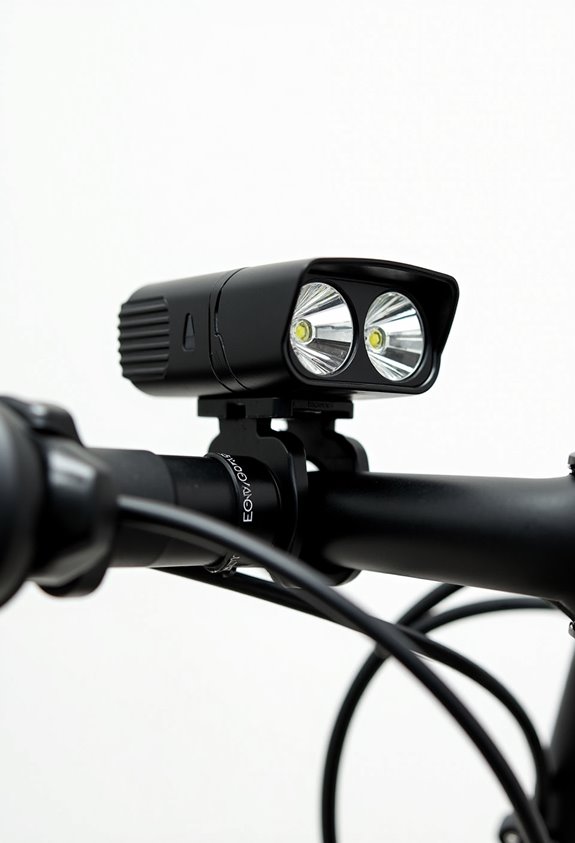
Front lights illuminate our path, helping us identify obstacles. Wide-beam lights provide broader visibility for urban cycling but may cause glare. In contrast, spotlights focus on distant terrain, which is useful for off-road rides. Options like handlebar-mounted and helmet-mounted lights allow flexibility in lighting direction. Many of the best lights, such as the 1000 lumens super bright bike lights, offer high lumen outputs for enhanced visibility.
Rear Lights
Rear lights enhance our visibility from behind, significant in low-light conditions. With outputs between 50 to 100 lumens, they guarantee safety. Many come with flashing modes to capture drivers’ attention.
Power Sources
Choosing between dynamo-powered, rechargeable, or swappable battery lights depends on our ride duration and logistics for recharging. Understanding these lighting technologies and beam types helps us select the best visibility solutions.
Recommended Products

🏍️eAhora Romeo Pro 2 electric bike for adults! 🛍️ Excellent value for money, let him unleash the beast within you!

【🔥2026 LATEST JULIET PRO II DUAL MOTOR VERSION🔥】2026 Upgraded Juliet Pro II Dual Motors ebike,Peak 5400W Dual High Speed Brushless Motors, 60V/70Ah Ultra Large 200+Miles Battery,Strength Four-link rear suspension, 7A Fast Charge, 20W Lumens Super-Bright Headlight, Multi-Function Colorful LCD Display with password setting and APP Control, Upgradeable Rear Rack Basket & Rear Bag.Unleash superior power and precision for an unmatched riding experience.

DOMINATE ANY TERRAIN WITH 50MPH RAW POWER & 6500W PEAK MOTOR:Unleash explosive torque from the 6500W peak motor to conquer steep hills, sand dunes, and rocky trails. This high-speed electric dirt bike for adults leaves gas bikes and competitors in the dust — experience adrenaline-pumping off-road performance that redefines full-size electric motocross. (Note: Check local laws before purchase.)
Factors Influencing Lumen Selection
Choosing the appropriate lumen rating for night cycling isn’t solely about brightness; it involves various factors that affect our visibility and safety.
Environmental Lighting Conditions
In urban areas, we typically need 100 to 250 lumens. For rural or poorly lit roads, brighter lights in the 400 to 800 lumens range are vital. Trail biking often requires 800 lumens or more for complete darkness. Additionally, the IPX5 waterproof rating of bike lights can enhance their reliability in various weather conditions.
Beam Patterns
The beam pattern also matters. Wide beams light up the sides, while focused beams are essential for distance. Quality matters; higher quality LED lights offer better lumen efficiency and longer battery life.
Riding Speed
Our riding speed impacts requirements too. Faster cyclists should opt for 500 to 1000 lumens, ensuring longer-range illumination for quick hazard detection.
Safety Statistics Related to Cycling Visibility
How do safety statistics illustrate the vital importance of visibility for night cycling? Research shows that over 50% of cycling fatalities occur between 6 and 9 p.m., a time when visibility is poor. Cyclist awareness is essential; studies indicate that most fatalities happen in areas without street lighting. About 35% occur under these conditions.
Visibility misconceptions lead many cyclists to believe they are more visible than they actually are. Frequent riders tend to have a better grasp of their invisibility compared to occasional cyclists. Effective use of lights and reflective gear greatly improves a cyclist’s conspicuity, but many underestimate these benefits. By equipping ourselves appropriately, we can reduce the risks associated with nighttime cycling and increase our safety on the road. Additionally, minimum brightness of 200 lumens is recommended for safety, ensuring cyclists are visible to motorists.
Durability and Practical Features of Night Lights
When it comes to night cycling, durability and practical features of lights play a significant role in securing safety and performance. We should prioritize lights made with durable materials like aluminum or high-strength plastic, as they resist impact and weather conditions. Look for IPX4 ratings for water resistance, confirming lights can withstand splashes and rain during rides. Additionally, consider models that offer high ratings for weather resistance, which ensure effective protection against dust and water.
Practical features enhance functionality, like quick-release mounts for easy attachment and removal. Multiple light modes, including steady and flashing options, allow us to adjust visibility based on conditions. Additionally, well-sealed charging ports protect against water ingress, extending the light’s lifespan. Together, these elements guarantee that we have reliable lighting for every journey, regardless of the environment.
Importance of Multi-Directional Lighting
While single-direction lights may provide some visibility, the true importance of multi-directional lighting for night cycling lies in its ability to enhance safety notably.
Enhanced Visibility
Multi-directional lighting offers key benefits by providing a 360-degree visibility profile. This feature prevents drivers from confusing cyclists with other objects and improves recognition by more than 50%.
Dynamic Recognition
Biomotion lighting systems, like illuminated pedals, highlight natural movement, enhancing cycling visibility. These systems improve detection distances considerably compared to static lights.
Comprehensive Coverage
Incorporating side and wheel lights reduces blind spots, especially in intersections. This integration ensures that cyclists are visible from all angles, promoting safer overtaking.
Optimizing Battery Life With Lumen Output
To enhance battery life effectively while maintaining sufficient lumen output, we need to understand the relationship between brightness levels and runtime. Higher lumen outputs, such as 1500-2200 lumens, may result in runtimes of just 1.5-2 hours. Instead, moderate settings of 700-1200 lumens can last over three hours.
Effective battery maintenance is vital, and using a light’s multi-mode output helps conserve energy.
Light positioning matters too; ideal angles enhance visibility without maxing out output.
Selecting the right mode based on ride conditions can greatly extend battery life, especially for longer rides. By balancing these factors, we can enjoy safer, more efficient night cycling while minimizing the need for frequent recharges.
Frequently Asked Questions
How Do I Choose Between Different Brands of Lights?
To choose between different brands of lights, we should prioritize brand reputation and examine their light features. User reviews and expert opinions can guide us to reliable options that suit our cycling needs best.
Can I Use Regular Flashlight Instead of Bike Lights?
Regular flashlights often lack sufficient brightness for cycling; they typically provide less than 200 lumens. The bike light advantage is that they’re designed for safety and visibility, ensuring we can ride confidently at night.
What Should I Consider for Light Positioning on My Bike?
When positioning our bike lights, we should consider the light angle and guarantee it covers visibility zones. Higher mounts enhance visibility, while angled lights reduce glare, making us safer on the road.
Are More Lumens Always Better for Safety?
More lumens aren’t always better for safety; it’s about finding that brightness balance. Too much can blind, while just enough enhances visibility without overwhelming. We should focus on the right lumens for our riding environment.
How Do I Maintain My Bike Lights for Longevity?
To maintain our bike lights for longevity, we should regularly clean the lenses, practice proper battery care, store them safely, and inspect for wear. This guarantees peak performance and extends their lifespan for night rides.