As an Amazon Associate, we earn from qualifying purchases. Some links on this site are affiliate links at no extra cost to you. Our recommendations are based on thorough research and editorial judgment.

How Do Roller Trainers Differ From Stationary Trainers?

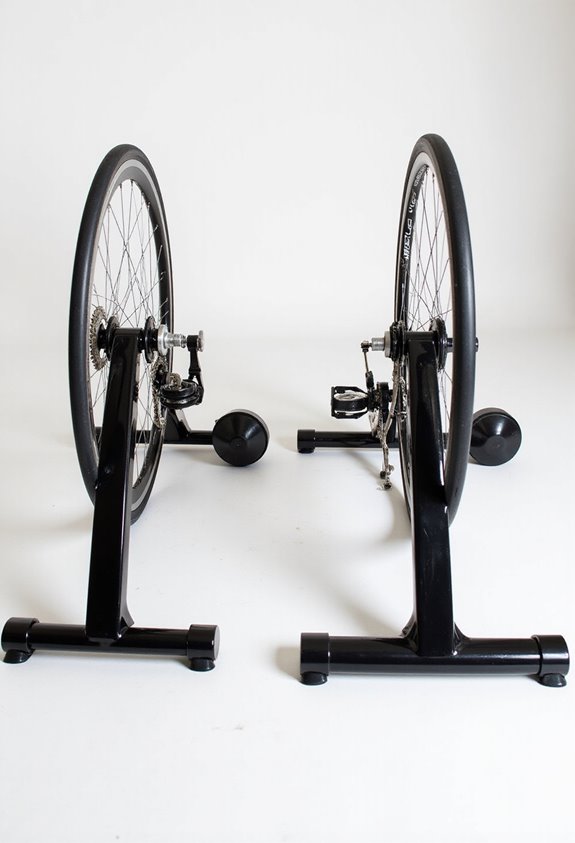
Roller trainers and stationary trainers serve different purposes in our cycling regimen. Rollers require continuous balance control, engaging core muscles and enhancing bike-handling skills. They simulate outdoor cycling ergonomically. In contrast, stationary trainers offer stability with adjustable resistance, focusing on defined workouts without lateral movement. While rollers promote dynamic muscle engagement, stationary trainers excel in structured interval training. Both have distinct advantages, and we can explore these differences to maximize our training outcomes.
Key Takeaways
- Rollers require continuous balance control, engaging core muscles, while stationary trainers offer a fixed platform that simplifies balance for beginners.
- Roller setups mimic real-road cycling, enhancing bike-handling skills, whereas stationary trainers focus on structured workouts without dynamic balance challenges.
- Resistance in rollers adjusts with speed for realistic simulation, while stationary trainers provide varied magnetic, fluid, or wind resistance options for tailored training.
- Basic rollers are generally more affordable and have lower maintenance costs compared to smart stationary trainers, which often exceed $500 in price.
- Rollers need approximately 15-20 square feet of space and allow for portability, while trainers usually require more setup space and additional accessories.
Design Mechanics of Rollers
You may be interested


When we examine the design mechanics of roller trainers, the construction materials and their configuration play vital roles in performance. Roller frames are typically lightweight yet sturdy, made from materials like aluminum or steel. This balance supports the rider’s stability while allowing them to maintain lateral movement.
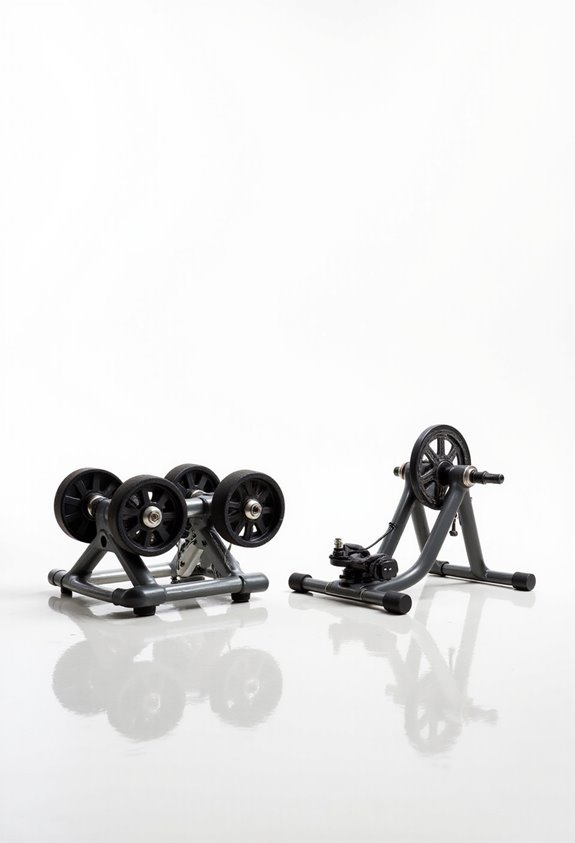
Rollers often utilize a three-roller system, featuring two rear rollers and one front roller. This design requires riders to actively balance, promoting stability and core strength.
Additionally, the rollers feature specially designed surfaces that enhance grip without causing excessive tire wear. The combination of these elements guarantees a realistic riding experience, contributing to the roller’s ability to simulate outdoor cycling effectively. Brightness levels are crucial to ensure visibility when riding outdoors, making understanding roller stability and frame design essential for the best training.
Design Mechanics of Stationary Trainers
Frame Stability
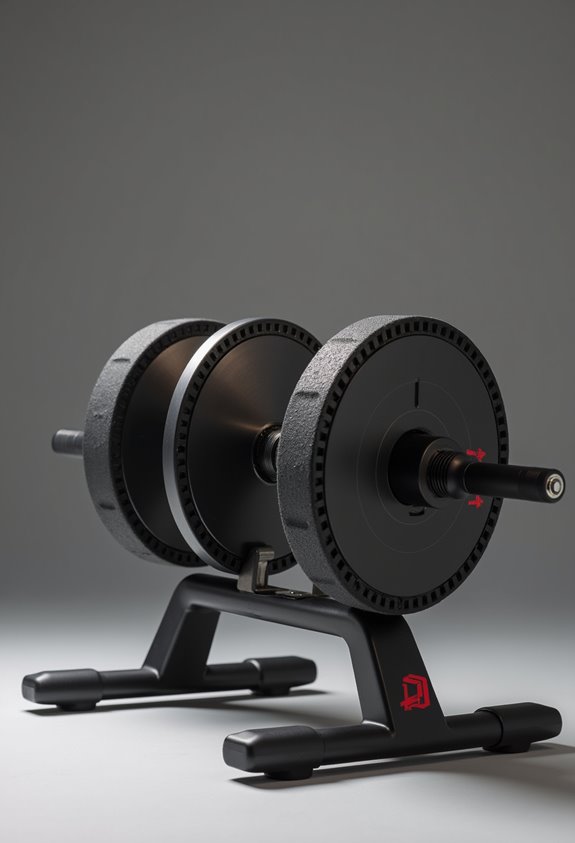
Stationary trainer features include a rigid frame that holds the bike in a fixed position to prevent lateral movement while pedaling. This guarantees that the frame stabilizes the bike over various ride intensities. Most designs accommodate different bike sizes with adjustable clamps or mounts.
Resistance Mechanisms
Resistance is generated using magnetic, fluid, or wind systems, providing varied experiences. For instance, magnetic resistance offers drag force without contact, while fluid resistance increases smoothly with speed, simulating real ride conditions. Many modern stationary trainers also utilize advanced connectivity options to enhance integration with cycling apps.
Safety Features
Clamping systems secure the bike against accidental dislodgment. Additionally, anti-slip feet enhance frame stability on smooth surfaces, guaranteeing a safe workout environment.
Balance and Rider Skill on Rollers
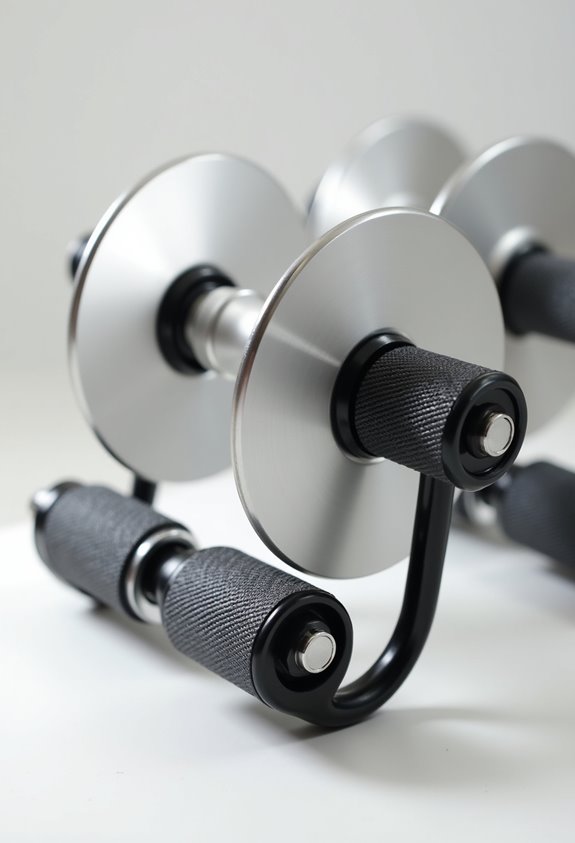
Rollers present a unique challenge for cyclists, requiring a balance skill set distinct from that of stationary trainers. Unlike stationary trainers, rollers demand continuous fine balance control due to their unrestrained lateral movement. This encourages the development of balance techniques that enhance dynamic stabilization skills.
During stability training on rollers, we engage our core and postural muscles more intensively than we would riding on a fixed bike. The front wheel’s self-steering is essential for maintaining a straight trajectory. Initial attempts can be challenging, as the risk of slipping off the side requires concentration and controlled pedaling. Ultimately, mastering roller riding translates to improved overall bike-handling skills, enhancing our ability to navigate outdoor cycling conditions effectively. Additionally, polarized lenses can significantly improve visibility during outdoor rides, reducing glare from the road and enhancing safety.
Balance and Rider Skill on Trainers

Cyclists working with stationary trainers encounter a very different set of skill requirements compared to those on rollers. The fixed and stable platform simplifies our bike setup, reducing the need for balance techniques. We’re able to focus primarily on leg muscle engagement, as minimal balance is required. This makes stationary trainers suitable for beginners who are starting their skill development.
However, the lack of lateral movement limits our ability to develop essential bike handling skills, such as core stability and proprioception. While we can engage in structured training sessions without distraction, this static environment means we won’t effectively prepare for dynamic outdoor conditions. Ultimately, stationary trainers simplify our training but may limit our overall handling skills when moving back to outdoor riding. Additionally, ultra-bright lights are important for enhancing visibility during nighttime rides, which can be crucial when transitioning back outdoors.
Recommended Products

Self-Generating. Electromagnetic resistance. 40 resistance levels. Oversized pedals for comfort.
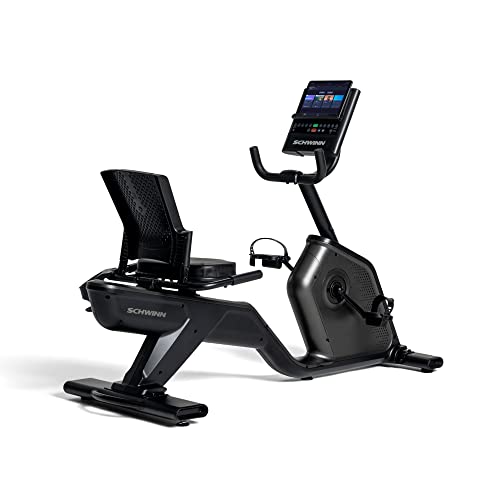
Try our JRNY Mobile-Only Membership for 2 months, free

【2-in-1 Fitness Machine】This innovative fitness machine combines a recumbent exercise bike and an elliptical machine in one design. Easily switch between two workout modes for low-impact cardio, full-body training, and effective calorie burning at home
Muscle Engagement With Rollers
When we use rollers, engaging our core and stabilizer muscles is essential for maintaining balance and control. This active stabilization is vital due to the absence of fixed support. As we ride, our core strength is consistently challenged, activating abdominal, lower back, and oblique muscles more than on stationary trainers.
The dynamic balance required on rollers closely mimics real-road cycling biomechanics. Smooth pedal strokes enhance muscle activation in the pelvis and hips, necessitating a straight line and preventing lateral movement.
Longitudinal studies show that this constant engagement may improve both core strength and proprioception over time. Ultimately, rollers require us to focus on technique and endurance, leading to better overall muscle engagement compared to stationary trainers. Additionally, the experience of riding on rollers can enhance ventilation and airflow management for improved comfort during longer sessions.
Muscle Engagement With Trainers
Understanding muscle engagement while using stationary trainers reveals distinct differences compared to rollers.
Core Engagement
On stationary trainers, core activation tends to be less consistent due to stable seating. However, standing during sprints can enhance core muscle activation. Dynamic cycling outdoors demands continuous core engagement, promoting balance and stability.
Lower Body Muscle Activation
Stationary cycling primarily activates quadriceps throughout the pedal stroke. Hamstrings, glutes, and calves are involved, especially under higher resistance. This consistent muscle activation leads to predictable patterns, unlike the variable muscle engagement experienced on rollers. Additionally, stationary trainers often provide adjustable resistance options to simulate different terrains, which can further influence muscle engagement during workouts.
Strength vs. Endurance
Resistance Control in Traditional Rollers
While exploring resistance control in traditional rollers, it’s important to recognize how their mechanics actively influence training dynamics. Traditional rollers primarily rely on manual resistance, adjusting resistance by changing the magnetic field strength or fluid dynamics. This makes the resistance more progressive and more fluid-like compared to older models. Modern innovations, such as some advanced rollers, now offer wireless adjustment options. This allows for real-time resistance changes during a ride, enhancing training flexibility. Riders can also adjust drum tension or resistance units, providing customization for intensity levels. Additionally, features like adjustable magnetic resistance can significantly enhance the training experience by simulating varied road conditions.
Resistance Control in Stationary Trainers
Resistance control in stationary trainers relies on various mechanisms that affect how we experience our workouts. Different resistance types include magnetic, fluid, electromagnetic, and mechanical.
- Control Methods:
- Manual control involves adjusting resistance with a knob or lever.
- Electronic control enables instant adjustments through software, providing real-time feedback during rides.
- Linear curves increase resistance directly with pedal speed.
- Progressive resistance adjusts sharply at higher speeds, enhancing realism.
- They offer near-instantaneous adjustments, simulating varied terrains efficiently. Additionally, many magnetic trainers provide adjustable resistance to cater to different fitness levels, enhancing workout versatility.
Cost Comparison of Rollers and Trainers
When comparing the costs of rollers and stationary trainers, several factors come into play that can considerably affect our purchasing decisions.
Initial Costs
Basic rollers start around $100-$200, while smart trainers typically exceed $500. Premium rollers may reach $400-$500, comparable to some mid-range trainers.
Ongoing Costs
Rollers have lower maintenance costs due to minimal parts. However, tire wear is an ongoing concern. In contrast, wheel-on trainers lead to increased tire replacement costs.
Accessories
Trainer setups often require additional accessories, such as speed sensors and special tires, which can elevate total expenses. Rollers typically lack these complexities, allowing for more straightforward roller maintenance. Additionally, tire selection plays a crucial role in noise management and overall performance when using trainers.
Recommended Products

Autonomous Cleaning with Self-Washing Roller Mops and HydroJet System: Enjoy hands-free operation as the robot self-cleans the roller mops 2 times per second in real-time, ensuring continuous freshness for seamless whole-home cleaning.

MASTERFULLY MACHINED DRUMS: Features aircraft-grade 6061 alloy drums turned on a CNC lathe to within two thousandths of concentricity for perfect balance. This precision construction provides the smoothest and quietest ride available on a roller system.

Innovative Floating System: Patented mechanism lets the bike “float,” improving stability and balance for a realistic ride feel.
Space Considerations for Rollers
Understanding the space requirements for roller trainers is essential for effective indoor cycling setups. Typically, our roller setup needs around 15-20 square feet of floor space, which is about 4 feet wide and 6-8 feet long. This guarantees floor stability and allows for safe mounting and dismounting.
Extra clearance around the rollers is advisable for ventilation and ease of movement. If we choose foldable roller models, they can be compactly stored, with dimensions reducing to approximately 23 x 22.25 x 8.25 inches when not in use. Additionally, lightweight aluminum frames aid in portability, making shifts between indoor and outdoor cycling effortless. Overall, planning for adequate space enhances both safety and performance during training sessions. Regular maintenance of your bike components is crucial for optimal performance, especially when transitioning between different riding environments.
Recommended Products

🏠 VERSATILE HOME STUDIO EQUIPMENT: Professional-grade foldable Pilates reformer perfect for home workouts, physical therapy, rehabilitation, prenatal/postnatal fitness, senior exercise, athlete training, and stress relief meditation. Ideal for beginners to advanced practitioners, fitness enthusiasts, yoga instructors, physical therapists, and wellness professionals.

【Ultra-Space Efficient】Entire smith machine fits in just 11 sq ft (approx. 1㎡), delivering full gym functionality even in compact home spaces. Perfect for home gyms and limited spaces.

Maximize Your Space - Transform any empty wall into a world-class power rack with Mikolo Folding Squat Rack. Foldable and space-saving, it only takes 15 seconds to switch between storage and use. Folded Size: 47''×2''×85.8''. Open Size: 47''×19.7''×85.8''. Get ready to pump some heavy iron without sacrificing your storage space.
Space Considerations for Trainers
Space considerations for stationary trainers are essential for optimizing workout efficiency and comfort. Standard upright bikes occupy around 6 to 7 square feet, while recumbent models need 8 to 9 square feet. For smaller spaces, foldable upright bikes minimize their footprint to 3 to 5 square feet and can store down to 2 square feet.
To enhance space efficiency, we should account for an additional 10 square feet of clearance around each bike for safe movement. Incorporating bikes in home offices or spare rooms promotes good room layout. We can use compact bikes in shared spaces like hallways. Proper placement in covered areas can improve ventilation, contributing to a comfortable workout environment and optimizing our use of space.
Recommended Products

An enhanced version of the Me-Mover Speed, which features upgraded materials and added accessories. Rechargeable light kit, GPS (optional), sports handlebar, foot cushions and more! Each order is custom-built.

INDUSTRY LEADER: For 30+ years, Body-Solid has held the widest array of products designed to meet the demands of the ever-changing fitness industry (home gym, free weight machines, treadmills, bikes, ellipticals, weight plates, kettlebells, dumbbells, flooring, accessories and more). Our products are cutting edge and reliable and are built for Life……Your Life.
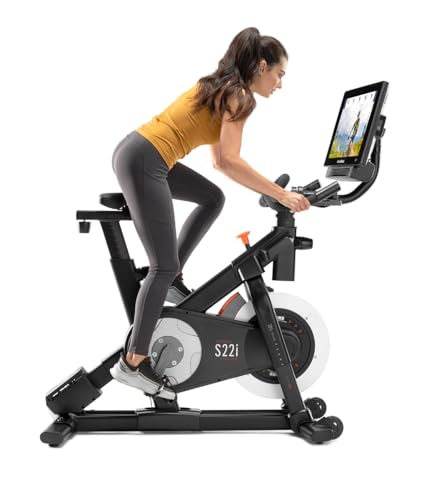
[Powered by iFIT] - Access over 10,000 workouts and features for a personalized experience. Get coaching by expert iFIT Trainers in workouts that adapt to your fitness level and goals with our SmartAdjust technology (Pro subscription required).
Effectiveness in Training Outcomes
Effectiveness in training outcomes varies considerably between roller trainers and stationary trainers, informing our choice for cycling workouts.
Neuromuscular Engagement
Rollers require active balancing, engaging our core and leg muscles, leading to greater muscle recruitment. In contrast, stationary trainers focus primarily on leg muscles without significant core participation. This difference positively affects coordination and muscle fiber recruitment.
Pedaling Technique
Using rollers promotes improved pedaling form and efficiency. The balancing challenge encourages smooth strokes, while stationary trainers don’t penalize irregular techniques.
Training Intensity
Stationary trainers excel in high-intensity sessions with structured intervals. Rollers foster sustained, steady-state efforts, enhancing cognitive engagement.
Physiological Adaptations
Studies indicate that while both improve performance, rollers may promise superior adaptations, impacting cycling efficiency metrics compared to stationary trainers in a training outcomes comparison.
Performance Improvements on Rollers
When we consider performance improvements on rollers, various factors contribute to how effectively they enhance our cycling capabilities.
Balance and Control
Roller training demands continuous balance, which engages stabilizing muscles often neglected when using stationary trainers. This engagement leads to better pedal stroke efficiency and improved bike handling skills outdoors.
Enhanced Focus and Skill Transfer****
Riding rollers requires enhanced focus, which fosters neuromuscular coordination and improves our reaction times. Additionally, skills such as cornering and standing pedaling are better developed on rollers, essential for technical riding.
Performance Metrics
Modern rollers, like the Wahoo Kickr Rollr, offer data-driven insights, bridging the gap with stationary trainers. By tracking performance metrics, we can adjust our training effectively and achieve significant improvements in overall performance on the road.
Performance Improvements on Trainers
Performance improvements on stationary trainers offer riders unmatched precision and control during indoor training sessions. These trainers enable riders to maintain power consistency with precise measurements of power output, cadence, and heart rate. This allows for targeted training in specific intensity zones, enhancing performance effectiveness.
Additionally, real-time feedback accuracy via smart trainers provides opportunities for micro-adjustments during workouts. This capability facilitates the attainment of specific training adaptations such as increased power, better endurance, and faster recovery.
The controlled environment eliminates external disruptions, ensuring productive riding time. By simplifying the calibration of training intensity through regular FTP testing, we can accurately track progress. Overall, stationary trainers support structured and efficient training, leading to significant performance improvements for dedicated cyclists.
Overall User Experience With Rollers vs. Trainers
While both rollers and stationary trainers have their unique advantages, the overall user experience can differ greatly based on physical demands and ride feel.
Physical Engagement
Rollers actively engage our core and balance, demanding focus and creating a dynamic workout experience. This enhances user satisfaction as we must adapt continuously. In contrast, trainers provide stability, allowing us to concentrate solely on pedaling, which some may find less engaging.
Ride Feel
Rollers closely mimic outdoor cycling, offering a natural feel by allowing side-to-side movement. However, trainers can lead to a more monotonous experience over time, though virtual platforms offset this.
Ultimately, choosing between rollers and trainers hinges on personal preference regarding user experience, engagement level, and physical demands. Understanding these differences can guide our decision effectively.
Frequently Asked Questions
Can Rollers Accommodate Different Bike Types and Sizes?
Yes, rollers can accommodate various bike types and sizes due to their roller compatibility. By adjusting the drum spacing for bike sizing, we enjoy a versatile setup for our road, mountain, or other bikes.
Are There Specific Safety Tips for Using Rollers?
To guarantee safety on rollers, we must practice balance techniques and maintain proper riding posture. Wearing protective gear and starting slowly can help us build confidence while minimizing the risk of falls and injuries.
How Do I Maintain My Roller Equipment?
To maintain our roller equipment, we should regularly clean them, inspect moving parts, and lubricate components monthly. Following these maintenance tips guarantees longevity and smooth performance, keeping our training sessions efficient and enjoyable.
What Accessories Enhance the Roller Riding Experience?
“When you’ve got the right tools, you make the ride smoother.” Accessories like non-slip roller feet, adjustable frames, and monitoring gadgets enhance our pedal efficiency, while proper tire maintenance keeps us safe and efficient on rollers.
Can Rollers Be Used for Training in All Weather Conditions?
No, rollers can’t be used for training in all weather conditions. Their stability decreases in wet environments, and weather impact on indoor humidity can affect performance and safety, necessitating controlled conditions for effective use.